
Patient Guide
Understanding VUS Results: A Patient Guide to Variants of Uncertain Significance
If your genetic test came back with a Variant of Uncertain Significance (VUS), you are not alone, and the result is not a diagnosis. This guide explains what a VUS is, why it happens, what the science says about reclassification over time, and how an independent scientific reassessment can sometimes turn complexity into clarity.
Medically reviewed by Prof. Paul Laissue, MD, PhDLast reviewed
What is a VUS?
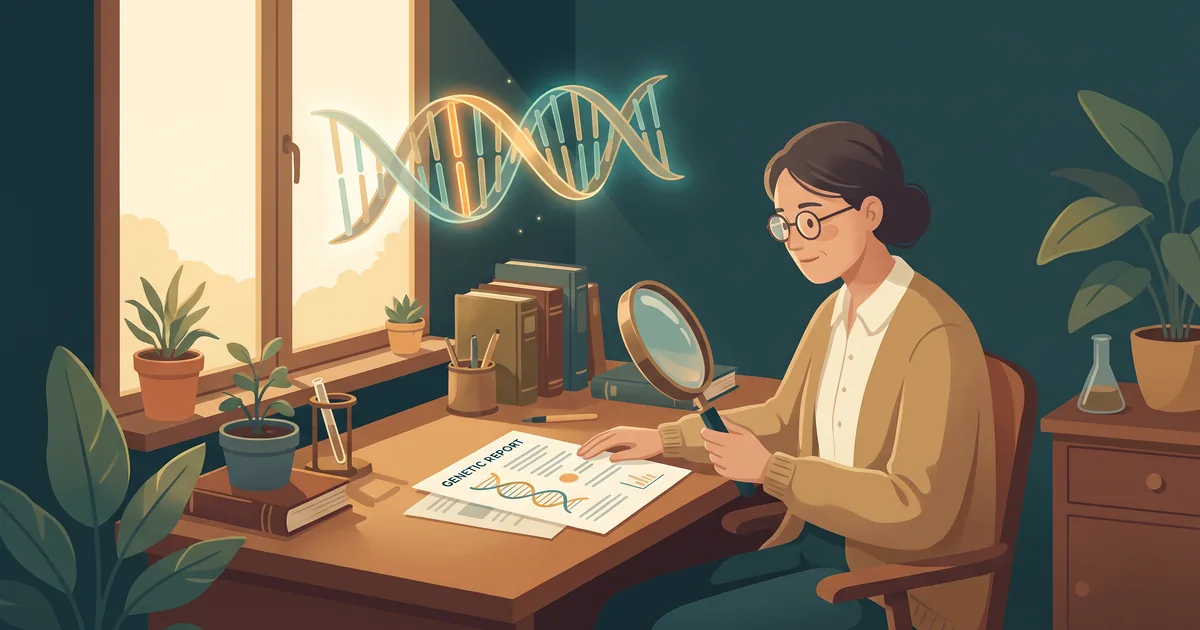
A Variant of Uncertain Significance (VUS, sometimes written as VOUS) is a change in a gene that has been detected by a genetic test but for which the current scientific evidence is insufficient to say whether it causes disease. It is neither confirmed as benign (harmless) nor confirmed as pathogenic (disease-causing). It sits in the middle, awaiting more data.
Receiving a VUS result can be unsettling. Many patients are told that their test is 'inconclusive' or that the laboratory 'cannot rule in or rule out' a genetic condition. That complexity is real, but it is a statement about the limits of today's evidence, not a statement that something is wrong with you.
Why VUS results happen
Modern genetic tests can read hundreds of thousands of letters of DNA across many genes at once. Every person carries a unique pattern of small genetic differences, and most of those differences are completely harmless. The challenge for the laboratory is to distinguish the rare, disease-causing changes from the much larger background of normal human variation.
A variant is reported as 'uncertain' when the laboratory finds a change that has not been seen often before, has not yet been published in the medical literature, or has conflicting evidence from different sources. This is especially common in rare diseases, in genes that have only recently been linked to disease, and in patients from populations that are underrepresented in genetic reference databases.
Which findings are even possible depends on the technology used. If you are not sure what your study analyzed, start with our guide on what a genetic test is.
How variants are classified
International guidelines from the American College of Medical Genetics and Genomics (ACMG) and the Association for Molecular Pathology (AMP) define five categories: Benign, Likely Benign, Uncertain Significance, Likely Pathogenic, and Pathogenic. Laboratories weigh many lines of evidence (population frequency, computational predictions, functional studies, family data, and clinical observations) to assign a category.
When the evidence for and against pathogenicity does not reach the thresholds required for a benign or pathogenic call, the variant defaults to Uncertain Significance. Crucially, the VUS category is the result of incomplete information, not of a 'half-pathogenic' biological state.
What a VUS means for you
Medical guidelines are clear: a VUS should not, on its own, be used to make treatment decisions, change surveillance plans, or guide reproductive choices. Acting clinically on a VUS as if it were pathogenic can lead to unnecessary procedures, anxiety, and harm to family members who may be told they carry a 'risky' variant that is, in fact, harmless.
At the same time, a VUS is not a clean bill of health. It is a piece of information that needs context: your symptoms, your family history, the gene involved, and the specific change itself. A careful scientific review can place the variant in that context and clarify what is known and what is not.
Living with that ambiguity is hard, and the reaction is normal. We wrote about it in our guide on fear and frustration after genetic test results.
Can a VUS be reclassified?
Yes, and this is one of the most important things to understand. The classification of a variant is not permanent. As more patients are tested, as functional studies are published, and as reference databases grow, variants are regularly moved from Uncertain to Benign or, less commonly, to Likely Pathogenic.
Published studies of reanalysis programs have shown that a meaningful share of VUS findings are reclassified within a few years of the original report. The majority of reclassifications resolve toward benign, which can lift years of worry. A smaller fraction reclassify toward pathogenic, which can finally explain a long-standing clinical picture and open the door to targeted care.
For when reanalysis is worth considering, and how a VUS sits alongside conclusive and negative results, see our guide on how to interpret genetic test results.
How scientific reassessment helps
An independent scientific review goes beyond simply revisiting a laboratory report. It involves a comprehensive analysis of the available genetic findings using advanced computational tools, current scientific evidence, genomic databases, and extensive expertise in human genetics and rare diseases.
The objective is not necessarily to change the original interpretation, but rather to provide deeper scientific insight into the findings and their potential biological relevance. In many cases, this process identifies new information from the rapidly evolving scientific literature, emerging gene-disease associations, functional evidence, or biological pathways that were not available or fully appreciated at the time of the original analysis.
For patients with rare diseases, this additional layer of expert review can contribute to a better understanding of the molecular basis of the condition, help place genetic findings into a broader biological context, and highlight relevant scientific developments that may inform future clinical or research considerations.
At PLH Genetics, this is one of our core areas of expertise. We provide independent, high-level scientific interpretation of genetic findings in rare diseases, leveraging state-of-the-art computational approaches and decades of experience in molecular genetics, genomics, and translational research to deliver clinically meaningful scientific insights.
Frequently asked questions
What is a Variant of Uncertain Significance (VUS)?
A VUS is a change in a gene detected by a genetic test for which current scientific evidence is insufficient to classify it as either benign or pathogenic.
Is a VUS the same as a positive genetic test result?
No. A VUS is neither positive nor negative; it is an inconclusive finding that current evidence cannot classify.
Can a VUS be reclassified over time?
Yes. As more patients are tested and more functional studies are published, variants are regularly reclassified, most often toward benign and sometimes toward pathogenic. There is no fixed timeline: some variants are reclassified within months, others take years. Periodic reanalysis is the best way to stay current.
Should I act on a VUS result clinically?
Medical guidelines advise against using a VUS alone to guide treatment, surveillance, or reproductive decisions. It should be interpreted in the context of your symptoms, family history, and the latest evidence, always with your treating physician.
Can PLH Genetics review my VUS result?
Yes. Independent scientific reassessment of VUS findings in rare diseases is a core part of our service.
Guides for navigating genetic results
Plain-language guides and updates on variant reclassification, written by our scientific team. No noise, and you can leave whenever you want.
Check your inbox
We've sent you a confirmation link. Click it and you're in — if it doesn't arrive in a few minutes, check your spam folder.
This content is for information purposes only and does not replace the evaluation, diagnosis, or decisions of your treating physician.